When Memories Meet Curiosity: Intergenerational Dialogues About Europe
How has Europe transformed everyday life over the decades? What does the European Union represent for younger generations today?
As part of the EUxFUTURE project, two intergenerational roundtables held in Aubagne and Aix-en-Provence brought together vocational students and citizens from different generations to share their experiences, memories, and perspectives on Europe.
Bringing Generations Together Through European History
On 27 January in Aubagne and 29 January in Aix-en-Provence, MARÉNA Services & Formation organised two intergenerational roundtables involving a total of 98 participants. The event welcomed apprentices from Roger Para Vocational Training Centre, teachers, youth wokers, former business owners, community members, and senior citizens who have witnessed many of the key milestones in European integration.
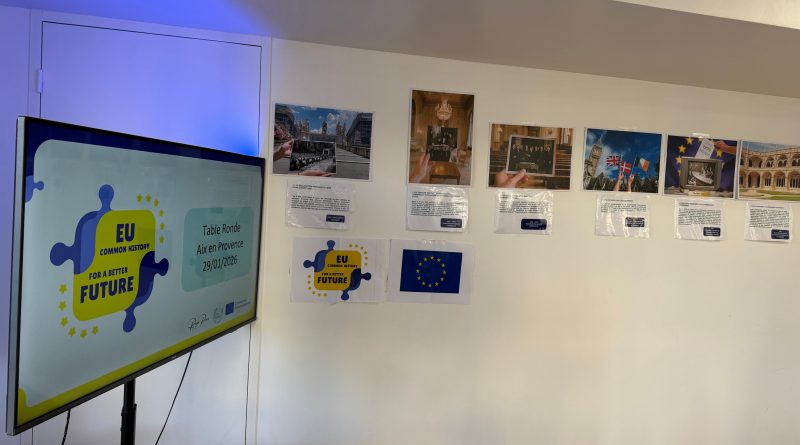
The activities began with a visit to the EUxFUTURE historical exhibition, which presented major milestones in the European integration process, including the Schuman Declaration of 1950, the founding European treaties, successive enlargements of the European Union, the Maastricht Treaty, the introduction of the euro, and the Charter of Fundamental Rights of the European Union.
The exhibition helped participants better understand how the European union has evolved over the decades and how it continues to
shape the lives of European citizens today.
Personal Stories Bringing History to Life
During the roundtable discussions, participants were invited to share their personal memories and experiences related to Europe’s evolution.
For many of the older participants, the introduction of the euro in 2002 was the most signifi cant European change they had experienced. Several participants recalled the transition to the new currency, the adjustments required in everyday life, and the feeling of belonging to a shared European space. These testimonies gave younger participants valuable insight into a period they had not experienced themselves but which profoundly changed the daily lives of millions of Europeans.
Other participants refl ected on the impact of the European Union’s enlargements. Discussions focused in particular on Spain’s and Portugal’s accession to the European Community and the population movements to France that accompanied this important stage of European integration. These conversations helped participants better understand the connections between history, mobility, and the development of European societies.
Participants from younger generations also highlighted the changes brought about by the European Single Market. Some recalled how new products, cultural infl uences, and consumer choices became more accessible thanks to the opening of borders and the strengthening of trade within the European Union.
Discovering Europe Through Future Career Opportunities
One of the most meaningful moments for the students from Roger Para Vocational Training Centre was learning about the opportunities offered by European citizenship in their future professional lives. Many students discovered that their vocational qualifi cations could enable them to work in diff erent European Union countries and that recognition mechanisms exist to facilitate professional mobility across the 27 Member States. This realisation generated considerable interest and discussion. It helped participants see Europe not only as a historical and political reality, but also as a space of concrete opportunities for their future careers and personal development.
Learning Through an Interactive Quiz
Following the discussions, participants took part in an interactive quiz on the history of the European Union. The questions covered major milestones in European integration, European institutions, shared values, and the key events presented throughout the exhibition. This engaging activity helped reinforce the knowledge gained during the day while encouraging interaction between generations in a friendly and collaborative atmosphere. The event concluded with a shared afternoon snack, providing a fi nal opportunity for informal conversations and exchanges among participants.
These roundtables demonstrated the value of intergenerational dialogue. The testimonies of participants who experienced major European transformations firsthand brought a human dimension to European history, while the questions and refl ections of younger participants offered fresh perspectives on Europe’s present and future. Participants gained a deeper understanding of how European decisions infl uence everyday life, whether through the single currency, freedom of movement, fundamental rights, or professional opportunities across Europe. Beyond the knowledge acquired, these meetings strengthened participants’ sense of belonging to a European community built on shared values such as democracy, solidarity, freedom, equality, and respect for fundamental rights.
These roundtables represent an important milestone within the EUxFUTURE project. The ideas, testimonies, and reflections collected during these events will contribute to future project activities, including artistic initiatives, exhibitions, and international exchanges with European partners.
By connecting memories of the past with the aspirations of younger generations, EUxFUTURE helps preserve European memory while fostering active citizenship and a shared vision for the future.
This activity is part of the EUxFUTURE project, co-funded by the European Union through the CERV Programme.