
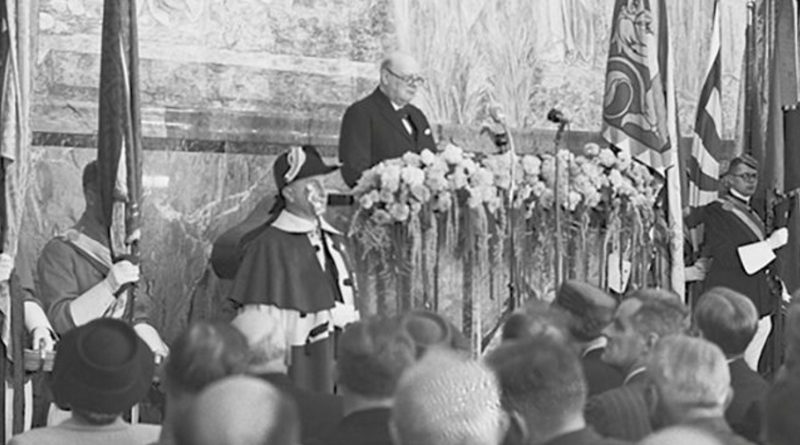
Winston Churchill and the Birth of the European Idea
On 19 September 1946, Winston Churchill gave a speech at the University of Zurich that would later be seen as a turning point in Europe’s history. Only a year after the Second World War, the continent was devastated, divided, and full of fear for the future. Churchill argued that Europe could not afford to repeat the mistakes of the past. He proposed a bold solution: to unite the countries of Europe in order to secure peace, stability, and prosperity. He famously declared: “We must build a kind of United States of Europe.”Doing so he was reviving a vision that had been circulating for centuries, reshaped by successive generations of thinkers and political leaders.
EARLY VISIONS
As early as 1713, the Abbé de Saint-Pierre imagined a federation of European states in his Project for Perpetual Peace in Europe. He proposed an alliance of Christian princes who would form a kind of supranational council to prevent war.
The 19th century gave new life to the idea. After the upheavals of 1848, many revolutionaries spoke of a European federation as the natural outcome of republican ideals. Victor Hugo became perhaps the most famous champion of the “United States of Europe.” Speaking at the Paris Peace Congress in 1849, he declared that a day would come when wars between European nations would be as unthinkable as wars between French provinces.
The vision did not die with the 19th century. In the 1920s, Russian revolutionary Leon Trotsky called for a “United States of Europe” as a way to stabilize the continent after the First World War, and to integrate Russia into a broader European framework. Around the same time, the Austrian writer Stefan Zweig, horrified by rising nationalism, also pleaded for a federal Europe. One of the most serious political attempts came in 1929, when French foreign minister Aristide Briand presented a plan for a “federal link” between European nations before the League of Nations even though it failed.
CHURCHILL’S INHERITANCE
This call was not about erasing nations, but about encouraging cooperation and reconciliation. The key, Churchill insisted, was a partnership between France and Germany, two countries whose rivalry had fuelled decades of war. Just a few years later, the Council of Europe was created, followed by the first European Communities in the 1950s. For many historians, Zurich marks the symbolic beginning of the journey that eventually led to the European Union we know today.
In May 2012, former Belgian Prime Minister and prominent federalist Guy Verhofstadt argued that European leaders would be “obliged” to move toward a federal state if they wanted to save the euro. The same year, German Chancellor Angela Merkel expressed support for creating a European finance ministry, albeit with a limited group of member states. Back then, French President François Hollande, however, was more hesitant.
In conclusion, the “United States of Europe” remains a living, if controversial, project that resurfaces whenever Europe faces existential challenges. From economic governance to climate policy, from migration to defense, the argument for deeper integration echoes the same logic Churchill voiced in Zurich: Europe can guarantee stability and democracy only through unity.
Disclaimer: Funded by the European Union. Views and opinions expressed are however those of the author(s) only and do not necessarily reflect those of the European Union or the granting authority. Neither the European Union nor the granting authority can be held responsible for them.