
Voices of Memory: Five Perspectives from Portugal on the European Journey
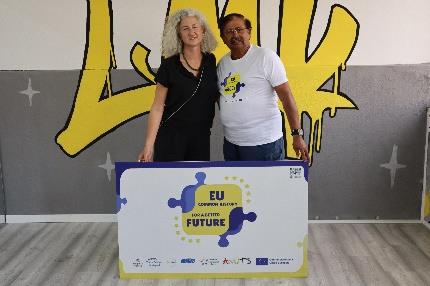
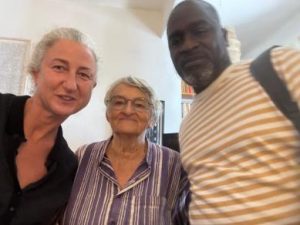
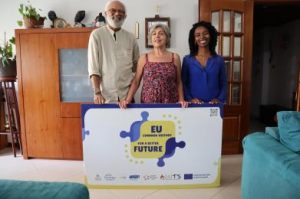
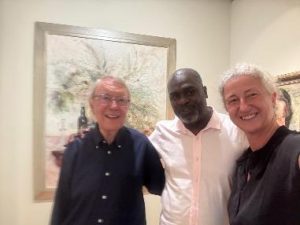
The the life stories of Pedro, Eduardo, Emma, Joaquim, and Lieve, aged between 70 and 90, the EUxFUTURE project delves into the memories of Portugal’s transformation. From a country isolated by a dictatorship to a full member of the European Union, their testimonies reveal the profound impacts, hopes, and challenges of our shared history.
What did joining the European Union mean for those who lived most of their lives before it? To answer this question, EUxFUTURE sat down to talk to four Portuguese citizens whose lives mirror the history of the continent itself.
For Emma Sequeira, 72, the most impactful moment was not accession in 1986, but rather the Carnation Revolution in 1974. “April 25 (…) allowed us to later join the European Union,” she reflects, emphasizing that democracy was the passport to Europe. She saw the benefits in the lives of her children, who had “the opportunity to go abroad to work and study.”
Eduardo, 78, born in a former Portuguese colony and a veteran of the colonial war, saw Europe as an opportunity to “make this country evolve.” He recalls a Portugal that was emerging from “50 years of fascism” and needed the example of European democracies to consolidate itself. The “amazing progress” in infrastructure is something that has left a deep impression on him. “I took a short trip and I no longer recognize Portugal,” he says, seeing this as proof of the success of integration.
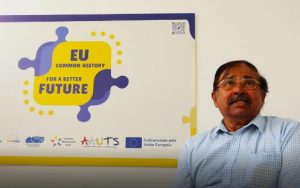
At 88, Pedro Canavarro has a unique perspective, as his life “has everything to do with the age” of European integration. Having actively participated in key moments, such as the organization of major cultural exhibitions that demonstrated Portugal’s “ability to meet its European obligations,” he experienced the transition from within. His election as a member of the European Parliament in 1989 coincided with the fall of the Berlin Wall. “I am coming with the parliament to make history,” he recalls telling a journalist on his arrival in Brussels, months before the historic event.
Joaquim de Bragança, 76, born in Mozambique, recalls accession as “a great step forward for Portugal,” a country that felt “far behind the rest of Europe.” For him, the benefits were visible and concrete, from the motorways that connected the country to the greater ease of traveling with his family. “When there is a single currency, it becomes much easier,” he recalls, describing the euro as the possibility of being “a free bird flying all over Europe.”
The perspective of Lieve Meersschaert, a native of Belgium who has lived in Portugal since 1978, adds a unique transnational dimension. Born a week before the end of World War II, her life has been marked by an awareness of the importance of peace. Having worked closely with the agricultural sector, she vividly recalls the initial tensions of integration. “What is much more important to me is the reaction of farmers,” she says, referring to protests in Brussels against policies that favored large companies over family farms. Her most transformative personal experience with the EU was in the 1990s, through the NOW (New Opportunities for Women) project, which brought European funding for the training of mediators in Lisbon’s social housing neighborhoods. “It was an eye-opener,” she recalls, highlighting how exchanges with partners in the Netherlands and France, and mutual recognition of knowledge, created a true spirit of European synergy.
The testimonies, although unique, converge on essential points. All recognize the transformative impact of infrastructure and freedom of movement. However, their views are not without criticism. Both Emma and Eduardo point to the initial “shock” of the transition to the euro. Joaquim and Lieve, each in their own field, maintain a critical view of the balance of power and economic policies.
Their messages to younger generations are a passionate call to defend fundamental values. Emma, who lived under the dictatorship, is categorical: “Democracy is an asset that cannot be lost.” Eduardo warns against “the siren songs of populists.” Joaquim calls on young people to actively defend the freedom they have today. And Lieve, with her experience in community mediation, emphasizes the importance of synergy and communication rather than competition. “The unity of Cape Verdeans, knowing how to work together (…) is what brings about change and progress.”
These stories are more than mere memories; they are living lessons in history and citizenship. The testimonies collected will be at the heart of the videos, photo exhibition, and round tables of the EUxFUTURE project. Our goal is for these voices to inspire an intergenerational dialogue about what it means to be European today and what future we want to build together.
Disclaimer: Funded by the European Union. Views and opinions expressed are however those of the author(s) only and do not necessarily reflect those of the European Union or the granting authority. Neither the European Union nor the granting authority can be held responsible for them.