75 Years on Rails: Cultural Mediation Activity in Budapest
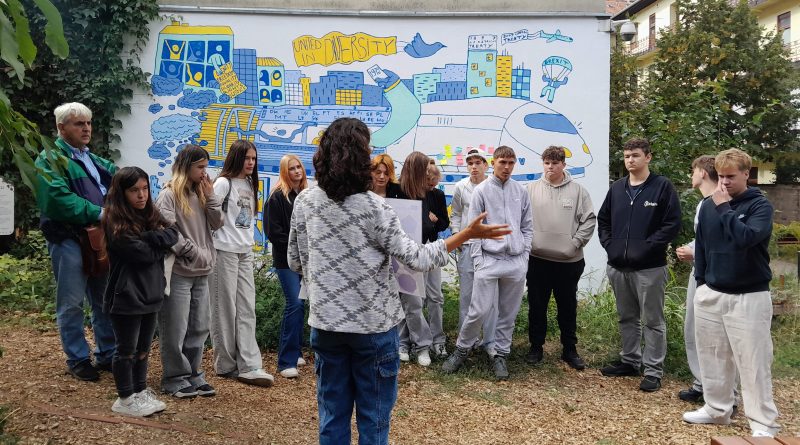
On 22 September, we gathered at Dankó Udvar with 25 students from Class 11.C of KMASZC Fáy András Agricultural Technical School for an interactive journey through 75 years of European history.
For many young people, European integration can feel distant at first: a series of treaties, dates, and institutions that belong to history books. This session was designed to bring that history closer. Instead of a conventional lecture, participants explored key milestones of European integration through a participatory “time-train” experience.
Our anchor for the experience was the instrument, the community mural. Standing directly in front of us. Before splitting into groups, we took time to observe it together the art, absorb its colors, geometry, and symbols. Participants began by identifying everyday elements in the artwork, trains, currency, pass, ticket for the train, windows, doors, houses, light. By recognizing these familiar symbols of daily life, abstract historical concepts instantly became grounded in tangible experience. With these foundations set, it was time to board the train.
Divided into three different groups, participants set out to solve a series of thematic quizzes (War/Peace, Expansion/Treaties, Values/Future) by finding the visual clues hidden within the mural. While some answers were just “right there”, others were harder to decode. Evaluating the questionnaire allowed us to mentally walk through key European milestones which became an open dialogue on Schuman’s famous speech, the fall of the Berlin Wall, and German reunification ‑events many participants would know through their parents’ stories-. This historical journey brought us exploring how foundational frameworks ‑the Maastricht and Lisbon Treaties and the EU Charter of Fundamental Rights- to shape our daily lives today.
Having navigated the past, it was time to change carriages and step into the Future. We opened this phase with a striking question: What would Hungary look like if it had never joined the European Union? The responses were grounded in reality, highlighting risks of economic hardship, isolation, reduced support, and weakened cohesion with neighbor countries. This shared realization served a seed for optimism: the group received sticky notes to write down their personal wishes, words, and visions for our collective future.
Which after ticking to our Future carriage we read out loud and found common dots in between.
We concluded our cultural mediation session with an interactive puzzle game highlighting concrete future opportunities available through Erasmus+ and the European Solidarity Corps (ESC). As the journey came to an end, it was evident that participants gained far more than historical facts. Together, we reconnected with our shared past, gained insight into how we reached this present moment, and yet we got curious and enthusiastic about a drive into a clearer, unified vision, our Future.