Art as a Tool for Democratic Learning
Democratic education does not happen only in classrooms, training rooms, or policy discussions. It also happens when people are invited to take part, to listen, to disagree respectfully, and to create something together. In youth work, these moments are often more powerful than any formal explanation of democratic values.
Art has a special place in this process. It gives shape to ideas that can otherwise feel too abstract: solidarity, freedom, equality, participation, diversity. These words are central to European and democratic life, but they become more meaningful when people can connect them to images, colours, memories, and stories.
This is especially relevant in international youth work, where groups often bring together people with different languages, backgrounds, and experiences. Not everyone feels confident speaking in a debate or presenting their opinion in front of others. Creative methods open other ways of participating. A drawing, a symbol, a photograph, a song, or a shared visual idea can become a contribution in itself.
Arts-based methods also allow difficult topics to be approached with more care. Questions around identity, belonging, memory, exclusion, injustice, or social change are not always easy to discuss directly. Art can create the necessary distance to begin the conversation, while still keeping it personal and honest. A visual image can say something that would be hard to express in a formal discussion.
In this sense, the value of artistic work is not only in the final result. The process matters just as much. When a group creates something together, participants need to make decisions, negotiate meanings, listen to one another, and accept that the final outcome may not belong to one person alone. These are small but very real democratic practices.
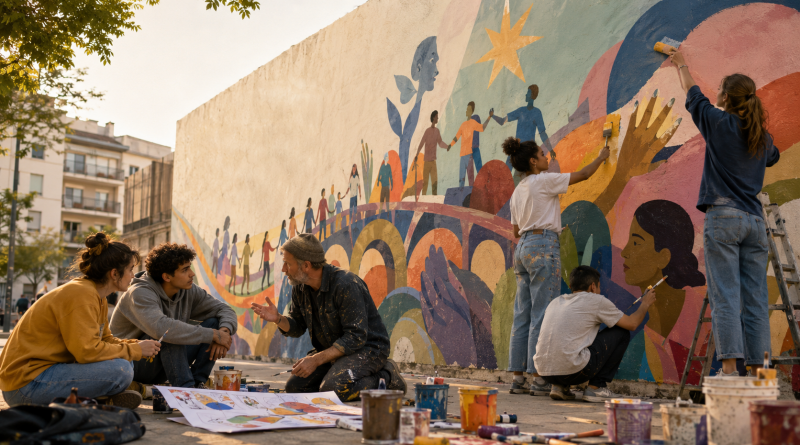
Public art adds another dimension. When an artwork appears in a shared space, it leaves the closed setting of a workshop and becomes part of everyday life. A mural can stop someone on their way to school or work. It can raise questions, start conversations, or simply remind a community of something worth remembering. It brings history and values out of official documents and into the places where people actually live.
This approach is closely connected to the EUxFUTURE project. The project explores 75 years of European integration, but it does not treat this history as something distant or finished. It asks how Europe’s common past can still speak to people today, especially through memory, dialogue, and participation.
Between May and July, EUxFUTURE partners are creating participatory murals that translate key moments of European history into visual and community forms. These murals are not only artistic outputs. They are opportunities for local communities to reflect on European history, discuss shared values, and take part in shaping a visible memory of the project.
By combining public art, youth work, and historical reflection, EUxFUTURE shows how democratic learning can move beyond words. It can happen through shared decisions, through creative expression, and through the simple but powerful act of making something together in public space.