
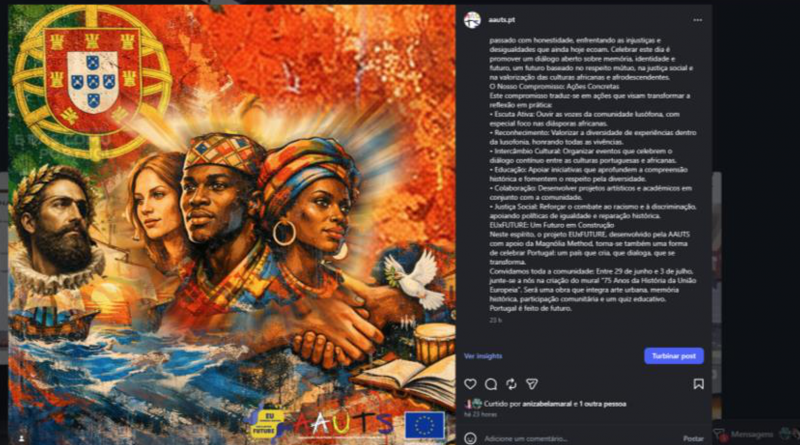
Article 5: Portugal Day, Camões Day and Portuguese Communities Day
Portugal Day is a moment of celebration, but also of critical reflection on history, Lusophony, and contemporary social challenges. Drawing on the memory of Camões, the African diasporas, and anti-racist struggles, this article proposes an interpretation of June 10th as a meeting point between past and future. In the context of EUxFUTURE, this date becomes action: a mural, a post, and a collective gesture that transform shared memory into a tool for social change.
June 10th is celebrated as Portugal Day, Camões Day, and Portuguese Communities Day. The date marks the death of Luís de Camões, a poet who crossed oceans, wars, exiles, and contradictions. He returned poor and ill, but brought with him Os Lusíadas, a work that shaped the country’s literary identity and influenced Europe.
The holiday, officially established in 1952, has become a symbol of national unity and a universal projection of the Portuguese language. This year, the official celebrations took place in the Azores, where the President of the Republic stated that June 10th is “celebrating 900 years of history, a collective memory and a sense of belonging that has survived wars, crises and regime changes “.
But this memory is not linear. It is plural, contested, and deeply marked by the relationship with Africa—a relationship that continues to define Portugal.
The Portuguese-speaking world as a living and diverse space
June 10th is also Lusophony Day , celebrated by millions of people on every continent. In the last 50 years, especially after April 25th, Portugal has become a country deeply influenced by its diasporas and the African communities that live here.
PALOP communities in Portugal and around the world have played a central role in building the contemporary country. Their presence has transformed: culture, the music, language, gastronomy and the very idea of “being Portuguese”
Lusophony is a space of encounters, tensions, affections, and the creation of a living territory, in constant reinvention.
Memory, justice, and the case of Alcino Monteiro
The collective memory of June 10th also includes episodes of violence and resistance. It is on this day that we remember Alcino Monteiro, a young Cape Verdean man murdered in 1995 by a group of nationalist extremists returning from the celebration of “Race Day”.
Five days later, thousands of people, anti-racist movements, Catholic associations, students, and immigrants marched in Lisbon, demanding justice and denouncing structural racism and police violence. This moment marked the beginning of a cycle of mobilization that continues to this day.
The plaque placed in 2020 on Garrett Street, at the site of the crime, has become a symbol of public debate about memory, racism, and historical responsibility.
Remembering Alcino Monteiro is to acknowledge that memory is not only celebration, it is also responsibility.
EUxFUTURE: Shared Memory as Action and Social Transformation
EUxFUTURE is directly linked to this reflection on June 10th. By celebrating this day with this article, this post, and the creation of the mural “75 Years of European Union History”, we are transforming shared memory into concrete action.
The memory evoked on this day, made of encounters, diasporas, struggles and demands, finds an echo in the work of the project. The mural that will be created between June 29th and July 3rd is not just an artistic work: it is a political, community and educational gesture that invites us to look at European and Portuguese history with honesty and participation.
Through urban art, EUxFUTURE seeks to:
— Bringing communities closer together through visual memory;
— To give visibility to stories that rarely make it into official discourse;
— To stimulate public debate on collective memory, inequality, and citizenship;
— Transforming urban space into a place of encounter and awareness;
— Involving young people and diasporas in the construction of shared narratives.
By linking June 10th to EUxFUTURE, we affirm that memory is not static: it is renewed when it is shared, discussed, and represented collectively. The mural thus becomes a real contribution to sharing the collective memory of European construction, and broadens its reach to address persistent social problems, from structural racism to the invisibility of Afro-descendant communities.
Celebrating Portugal Day through EUxFUTURE is to acknowledge that the future can only be built when we face the past with courage.
the EUxFUTURE is recognizing that the future is only built when we face the past with courage.
June 10th is a mirror in which Portugal sees itself—with its greatness and contradictions. Through urban art, community participation, and shared memory, EUxFUTURE transforms this date into a gesture of hope and responsibility. Portuguese identity is multifaceted, made up of diverse voices, and only strengthens when all are heard.