
History of Malta’s Integration
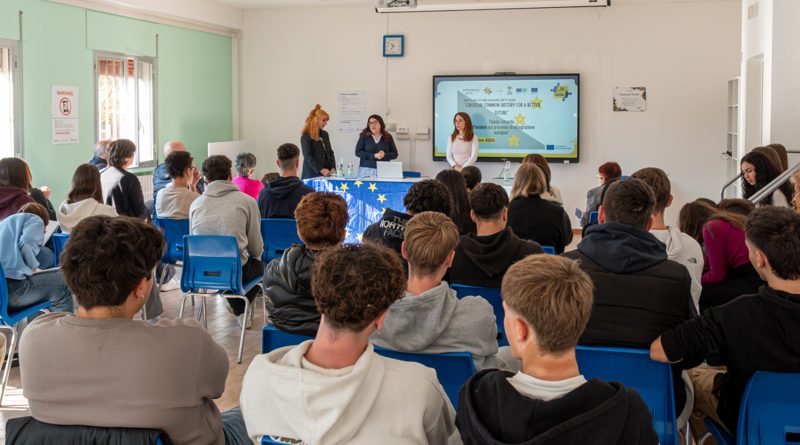
On Monday 13 October, a round table was held at the Salvatorelli-Moneta institute, organized by the Travelogue association, in which the students of the institute participated with their teachers, the guests of the video interviews of the CERV EuxFuture project and two guests from Malta, as required by the project.
It was interesting to hear the point of view of the Maltese guests, Josianne and Annie, regarding Malta’s integration into the EU: its accession to the European Union in 2004 represents one of the most significant chapters in a transformation process that has seen the island evolve from a British colony to a full member of the European community; And for this reason, the Maltese guests were very proud to tell and explain how this emblematic choice was a choice of great positive change and hope for the future.
Malta has always had a deep connection with Europe. Its strategic position in the Mediterranean Sea has made Malta a crossroads of trade and influence, but also a target for great European and non-European powers.
In 1964, Malta gained independence from the United Kingdom, but continued to maintain close ties with England, adopting a policy of non-alignment during the Cold War. However, as the 1980s and 1990s progressed, the island began to feel the pressure of increasing globalization and a new era of European cooperation.
The first official step towards the European Union came in 1990, when Malta expressed its intention to join the Association of Central and Eastern European Countries (CEEC), a group that aimed to foster cooperation with the EU. However, the beginning of the actual accession process took place in 1993, when Malta officially submitted its candidacy to become part of the European Community. This act was emblematic of the island’s desire to embark on a path of modernization and economic development, inspired by the economic and political successes that many other European countries were experiencing at that time.
Accession to the European Union required Malta to meet a set of criteria set out in the Maastricht Treaty (1992) and the EU enlargement strategy. Starting in the mid-1990s, Malta initiated a series of reforms that touched on various sectors, including justice, education, health and the environment.
The decisive step towards accession came in 2003, when Malta held a popular referendum to determine whether the island should become a member of the European Union. The result of the referendum was about 53% in favor, a margin that, although not overwhelming, clearly marked the will of the population to take the European path. On 1 May 2004, Malta officially became a member of the European Union, along with nine other countries.
From an economic point of view, EU membership has brought a number of benefits for Malta, such as access to a common market, increased opportunities for foreign investment and the strengthening of the tourism sector. In terms of internal policies, Malta has seen its democratic institutions strengthened and has benefited from European funds intended to support infrastructure development, technological innovation and the environment.
The Maltese say that Malta’s path towards the European Union has been a long and articulated path, which has required sacrifices, but which has also offered great opportunities. Today, Malta is a prosperous, modern nation integrated into the European fabric, with a strong economy, a solid democracy and a strategic position in the Mediterranean that allows it to play an important role in European and global politics. For them, EU membership has opened up new possibilities for the country, helping to strengthen its European identity and ensure a future of growth and stability. In fact, they concluded their speech in front of the round table with the motto “Long live Europe! Long live Italy and long live Malta!” expressing their gratitude to be part of a united and cohesive European community.
Disclaimer: Funded by the European Union. Views and opinions expressed are however those of the author(s) only and do not necessarily reflect those of the European Union or the granting authority. Neither the European Union nor the granting authority can be held responsible for them.