
From Memory to Dialogue: EUxFUTURE Brings European History to Life in Lisbon
Over the last quarter, the EUxFUTURE project in Portugal, led by AAUTS, moved from the intimate phase of memory collection to a vibrant period of public engagement. After editing and publishing the powerful video testimonies of five senior citizens, the project hosted a series of community events, including creative workshops, a compelling photo exhibition, and a highly successful international round table, successfully transforming personal stories into a collective dialogue about Europe’s past, present, and future.
The period from October 2025 to January 2026 marked a crucial transition for the EUxFUTURE project. The initial phase of capturing history concluded with the meticulous editing of the five video interviews conducted with senior citizens. These stories, once finalized and uploaded, became the heart of our dissemination strategy, shared across social media and serving as the emotional core for all subsequent activities.
In October, we brought these memories into a creative space with our Intergenerational Workshops. Held at the Campo de Ourique Library, these sessions invited the community to translate their own perceptions of Europe into artistic collages. The first workshop was a resounding success, proving that hands-on art is a powerful tool for sparking dialogue between generations. While the second session faced challenges in attendance, it provided a valuable lesson, prompting us to refine our outreach strategies for future events.
January was the culmination of our “Cycle of European Memories.” On January 8th, we inaugurated the Photo Exhibition “Portugal and Europe: 75 Years of Common European History.” The 17 panels, which combined historical photos with portraits and quotes from our interviewees, created an immersive experience for all visitors. The exhibition served as the perfect backdrop for our main event, the Round Table “Stories of Integration,” held on January 17th.
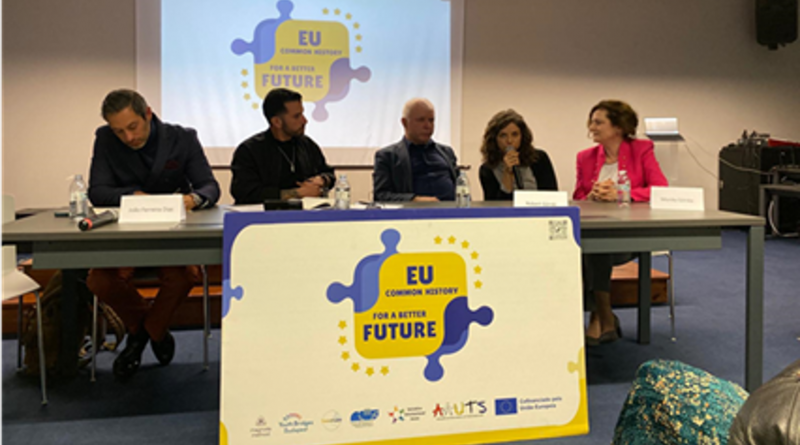
The round table was a resounding success, gathering an international audience of 40 people. The debate was opened with the screening of our video “A Common European History for a Better Future,” which immediately set an emotional and reflective tone. The panel, featuring Prof. João Ferreira Dias and Polish civil society activists Monika and Robert Górski, and moderated by Viriato Villas-Boas, engaged in a profound discussion. The powerful testimony from Robert Górski about his struggle for democracy in Poland resonated deeply, bringing a tangible, human dimension to the values of freedom and union. The active participation from the audience, including a young international relations student questioning the rise of populism, proved that these topics are more relevant than ever. The event concluded with a beautiful and introspective cello performance by Jeremy Lake, leaving the audience moved and inspired.