Budapest Roundtable: Reflecting on Europe’s Past and Future
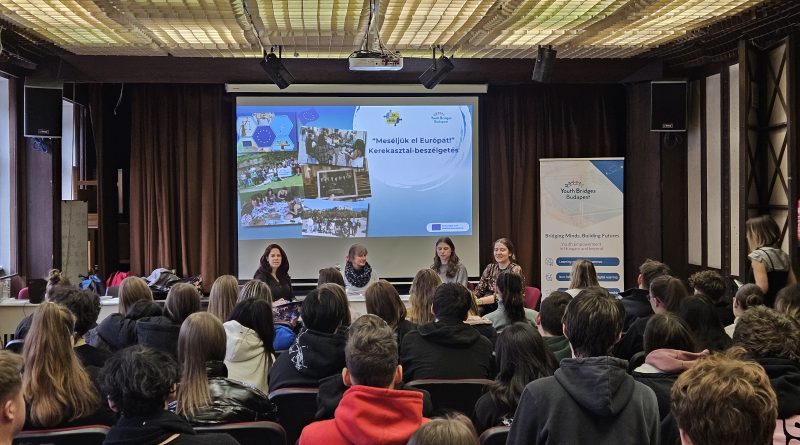
On 3 December, Youth Bridges Budapest, the Hungarian partner of our project organised an intergenerational roundtable discussion in Budapest, hosted at a vocational education and training (VET) high school. The school setting gave the conversation a very concrete frame: Europe’s history and future were discussed in a place where young people are preparing for their professional and personal paths.
The roundtable was designed as an open discussion rather than a formal event. After a short introduction to the EUxFUTURE project, participants were invited to reflect on personal experiences and memories connected to Europe and European integration. Instead of starting with abstract concepts, the conversation began with simple, direct questions: when did Europe first become meaningful in your life, and what changes do you associate with it?
The older participant shared memories of political transitions, closed and opening borders, and everyday life before and after major historical turning points. Students listened closely and asked practical questions: what these changes felt like at the time, how quickly everyday life actually changed, and what opportunities or uncertainties people experienced during those periods.
The discussion gradually moved towards the present. Participants talked about how perceptions of Europe have evolved, what the European Union represents today, and how past experiences influence current attitudes. Being in a VET high school added an important layer to the conversation, as questions about work, mobility, and future opportunities naturally emerged.
Rather than aiming for clear answers, the roundtable created space for exchange. Different perspectives were shared openly, sometimes agreeing, sometimes diverging, but always grounded in lived experience. This made the discussion tangible and relatable, especially for the younger participants.
The Budapest roundtable connected closely with other EUxFUTURE activities, such as the video interviews and the photo exhibition. Together, these elements show how European history can be explored not only through facts and dates, but through conversation, listening, and reflection.
By the end of the session, it was clear that intergenerational dialogue works best when it takes place in familiar, everyday environments. Hosting the roundtable in a school helped bring Europe’s history closer to the present — and closer to the young people who will shape its future.
Disclaimer: Funded by the European Union. Views and opinions expressed are however those of the author(s) only and do not necessarily reflect those of the European Union or the granting authority. Neither the European Union nor the granting authority can be held responsible for them.